
How to play - Quick guide
Fish n’ Ships is a card game developed to communicate ecological knowledge on marine ecosystems and on the sustainable management of its resources used by fishing. The game is based on key concepts such as trophic levels, ecological pyramid, importance of fisheries and its correct management. Try fishing in a sustainable way in your sea to obtain more points than the other players
The cards represent 36 different species of the Adriatic Sea divided into 4 groups based on their position in the food chain (Trophic level; note 1): primary producers or autotrophs (green cards), primary consumers (yellow cards), secondary consumers (orange cards), tertiary consumers (red cards).
In the first phase of the game the players have to develop their own marine ecosystem, in which there must be organisms from all trophic levels.
A player with a healthy sea (i.e. with at least one red card) can start the second phase of the game: use the fishing cards to fish in the player’s own sea.
Every player starts with eight fishing cards, each one corresponding to a fishing technique commonly used in the Adriatic Sea, with their target species and secondary effects on other species.
There are other cards related to human activities or natural events that may affect the game by adding uncertainty and unpredictability, but also incrementing interactions among players. Some of these cards have positive effects on marine ecosystem and are called “Bonus” (Marine protected areas, Fishing innovations) and some others have negative effects and are called “Malus”(climate change, eutrophycation, illegal fishing, alien species).
Scores are assigned based on the healthy status of the player’s sea and on how s/he fished in a sustainable way. The total score is thus obtained by giving one point for each species present in the sea at the end of the game, plus the points associated to each fished species (top right corner). The fishing activities applied have also a score based on the socio-cultural value of the activity (top right corner of the card). Extra score is obtained for some achievement earned during the game
Some features of the game enable understanding key concepts of the marine ecosystem and its sustainable use.
The color of cards (green, yellow, orange and red) is linked to the trophic level of the species. The trophic level is the number of passages that the energy makes in the food chain. Using the primary producers as the base trophic level equal to 1, then the herbivores (primary consumers) have trophic level 2, the carnivores (secondary consumers) have trophic level 3, etc. Some marine species such as big sharks and tunas can reach up to trophic level 5 and are called top-predators (or apex predators).
An ecological pyramid is a representation of the biomass produced at each trophic level in the ecosystem and it decreases naturally when moving to higher trophic levels. The pyramid has the primary producers at the bottom (for example marine plants), on top of which are the next trophic level (herbivores), followed by the secondary carnivorous (predators of herbivores). The highest level is the top of the food chain.
Malus cards represent bad events or habits that cause damage to the ecosystem, like climate change or illegal fishing. All these events impact directly or indirectly on all marine organisms
Bonus cards represent good events or habits for the ecosystem, like the establishment of Marine Protected Areas or innovation in fishing techniques
Some fishing equipment although directed toward target species can produce accidental damage to the marine ecosystem and other species. The secondary effects of fishing could be: - Damage to habitats, as those produced for example by fishing equipment that impact the sea bottom. - Direct damage on non target species that can be accidentally caught (by-catch) representing the pool of unwanted creatures that are discarded during fishing operations (discard). Selective fishing equipment are those that catch mainly target species, avoiding harmful wastes represented by the discard.
To win the game, a player must fish in the most sustainable way, as fishermen in real life.
Login and begin a new game or join a current game. Game can be played from 1 to 4 players
fish in a sustainable way in your sea in order to obtain more points than other players.
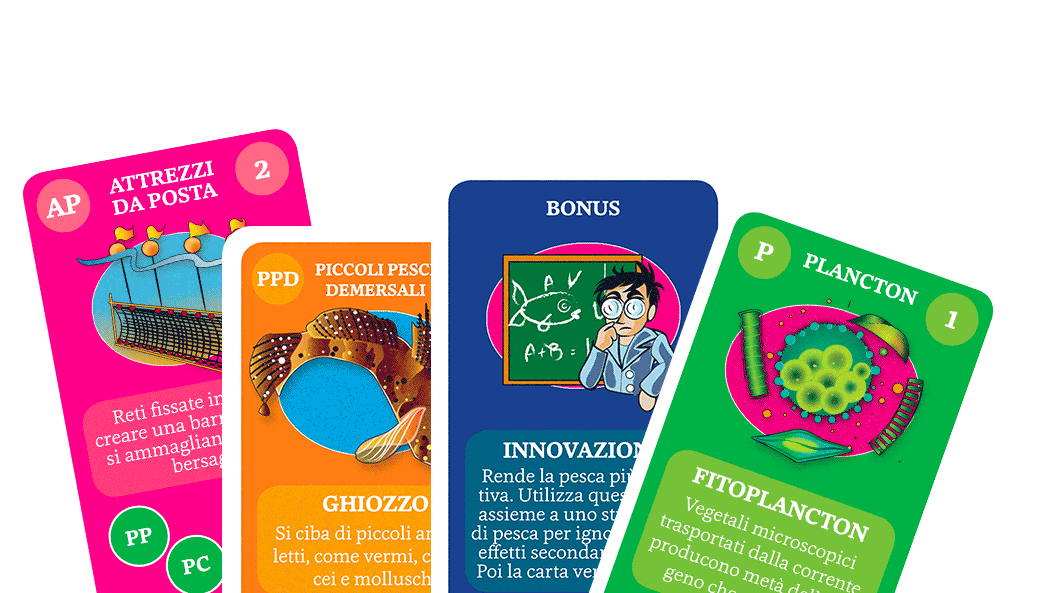
Every player starts having eight fishing cards, each one corresponding to a fishing technique commonly used in the Adriatic Sea. Five cards are in the middle of the table. In the first phase of the game the players have to “build” their marine ecosystem, which must include organisms from all trophic levels. At every turn, each player can pick up one card among the five uncovered in the middle of the table, add the chosen card to his/her ecosystem. The number of producers (green species cards) that can be placed in the marine ecosystem of each player is unlimited, while the following trophic levels (yellow, orange and red species cards) can have at maximum one card less than the trophic level below. During the game, if a card is no more sustained by the level below, it will be lost by the player. A player with a healthy sea (i.e. with at least one tertiary consumer- red card) can start the second phase of the game: fishing in their own ecosystem. The player can choose a fishing technique and cannot pick any card from uncovered cards in the middle of the table during the same turn. On the fishing cards are indicated the target species (green circles) that can be caught with that specific fishing technique. On each species card are indicated the techniques that can be used for fishing that species. A fishing technique is applied during the turn by removing one species that can be fished from the player’s own sea. If the fishing technique admits damages on species (indicated in red circles) the player will also lose one damaged species from his/her own sea. When fishing, the players must be careful on possible negative effects of their actions. Each fishing technique can be used only once: the used fishing card is collected by each player together with the fished species to be counted at the end of the game in the final score. The game ends when a player applies five of the eight fishing techniques. Malus and bonus cards are events that have positive or negative impacts on marine ecosystems. When a card is turned over from the deck, all players are immediately affected by.
In some cases, a player could face the situation in which no action is possible. In this situation, player can shuffle the play deck and other five cards are uncovered in the middle of the table, loosing one point.
At the end of the game, each player counts theirown score in this way: Each species card belonging to the player’s ecosystem will count 1 point. Species cards that have been fished have the score indicated on the top right of the card as well as fishing cards that have been used. Extra score is obtained for the achievements earned during the game. Total score is the sum of all these points. The player with the highest score wins.
There are 7 types of cards, with seven different colours